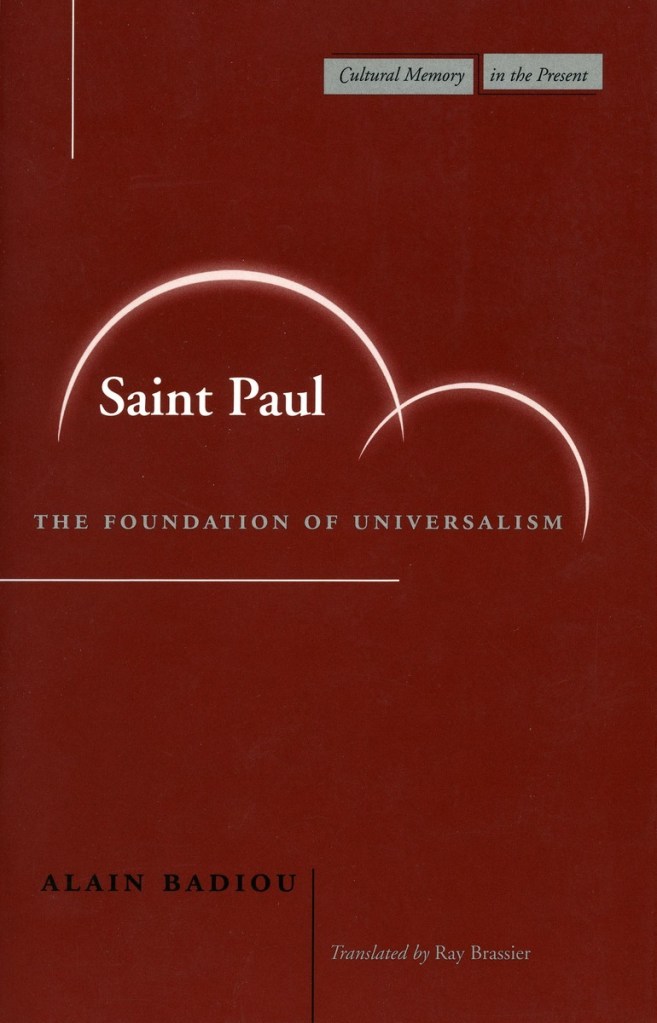
	With war breaking out in Europe in late February, the postmodern fog unleashed by the supposed death of history some three decades ago appears to be lifting, and suddenly - particularly in the West - many are now confronted with the stark reality of what could be called (the end of) the end of truth. While this crisis represents yet another long-awaited moment for the left to make a serious intervention, the stark reality of the situation is that we have very few resources to assert a new universalism required to build a socialist project which could traverse the particularity of identity politics and win international working-class power. We are suddenly confronted with the fact that thirty-some years of capitalist postmodern refraction has effectively sapped politics of a universal scope capable of challenging power, producing instead a micro-politics of hyper-identification. It is in this moment – of the revelation of the poverty of particularity - where Alain Badiou offers us a surprising gift. Where a new universalism is desperately needed, Badiou turns to an unlikely ally in the task of cultivating a revolutionary subjectivity, a subjectivity capable of meeting our critical moment. This is the undertaking of his groundbreaking text St. Paul: The Foundation of Universalism.

	It may come as a shock that Badiou – an atheist, a communist and a Lacanian theorist - would resurrect a figure associated in the popular imaginary as the founder of one of the most reactionary institutions in human history, but Badiou does so here without irony or apology. With the same disinterest in the person of Jesus as Paul himself modelled (Badiou notes that Paul has no need for parables, miracles; for the biographical details of Jesus) the author asserts that Paul is to us a towering revolutionary figure, a figure who was truly capable of being "all things to all people": a politician capable of knowing when to fight and when to compromise, a party leader - building cells of resistance throughout the Roman Empire, an "antiphilosopher" - waging a war against religious law and Greek "wisdom"; but above all, the thirteenth Apostle incarnates in true Leninist fashion, the archetype of a militant possessed by a truth. This truth - what Paul identified as “the Resurrection” - is not the neo-gnostic rejection of the world to save the soul, as the nihilistic anti-gospel of today's Christianity preaches, but is rather the product of a rupture; the end of history within history, resulting in an opportunity of a genuine universalism, a universalism which can even today provide a new foundation for politics of liberation at (the end) of the end of history.

	For Badiou, Paul is not just another philosopher or theologian, but is a figure who bears the heavy crucifix of truth - a possession he calls "the passion of the real". As we know from the book of Acts, this was always the case for Paul (or Saul as he was once known) who was always a militant. Prior to his conversion, Saul was a religious fanatic - a Pharisee and a Zealot for the law, who dedicated his life to destroying the early Christ-followers – a small group which was then considered by the Second Temple establishment to be a dangerous heretical sect. As the story goes, Saul's mission to wipe out the followers of Christ goes awry on the road to Damascus, where he is struck blind in an encounter with the real - that his persecution of the heretics was in fact an assault upon God -- that the body of Christ did not expire on the cross, but was now incarnated by the believers of the Christ-collective. This encounter with the real ruptured Saul's symbolic network, who remained blind for three days only to be revived as a convert, as a militant for the truth of the Resurrection - a subjective transfiguration which would temporarily turn a heretical Jewish sect into a new scourge upon the Empire. Badiou, (who sees the Italian Marxist Pier Paolo Passolini as one of the most faithful biographers of the Apostle in his fictional screenplay "St.Paul") focuses on the subjective details of Paul in equal measure to his doctrine, seeing this transformation as the proof of the truth of his conviction. For Badiou, Paul is not the bearer of truth based alone on the merit of his thought, but rather is enacted through his radical self-identification with the event of the Resurrection, an experience which occurred in his own subjectivity, re-ordering not only his own symbolic network, but also re-ordering the entire Jewish and Gentile world in what he immediately recognized as an absolutely new universality - a universality which was in fact a declaration of war on the false universality of Rome.

	Badiou does not see Paul as an empty placeholder to be fulfilled by the advent of Leninism, but rather engages with Pauline thought on its own terms: his wager being that in order to transplant the Pauline revelation of universality into our own time, its disruptive power within antiquity must be understood on its own terms. While the Pauline concept of the Resurrection is undeniably a fable, (Paul did really believe that Jesus was physically resurrected from the dead) Paul's novelty lies in the fact that for him, the Crucifixion (repeated symbolically by the believer in baptism) had the power to enact a subtraction of identity (the cross as the zero-point of subjective disruption) capable of erupting within the subject as an immediately universalizable singularity which shatters both the law and one's identiarian singularity through the subjective experience of the death of God/the loss of the big Other. It is then through the Resurrection where the believer is reconfigured as a subject, a subject bound to a Christ-collective comprised by those cast off by the old world of the law and of the pagan authority of Greco-Roman metaphysics. The horizon of universality is thus that of “foolishness” of an inverted horizon of the world's trash, who along with Christ. comprise the vanguard of a new world. This was then as it is now a revolutionary innovation; (lets not forget the class dimension here, where Christianity became the first system to give roman slaves and indentured labourers a genuine subjectivity) for just as the false universality of capitalism (the false “All” of liberalism) can only be shaken by the competing universality of world socialism, so too the false universality of the cult of the Emperor was shaken by the declaration of the Resurrection, a rupture that in effect eventually required Rome to subsume Christianity into itself in order to maintain the ideological hegemony of the Pax Romana – “the Peace of Rome”.

	If the Resurrection is the event - the eruption of the real which Paul declares fidelity (faith) to, then it is given that this faith requires a transformed subject. Such a subject experiences the Christ-event as an internal division – initiating a war between “the Flesh” (sin/law/death) and Spirit (renewal of thought/the eruption of new life/pure grace). This split has nothing to do with a metaphysical or a Gnostic division (soul vs. matter), but is the naming of a new subjective conflict within every militant of a truth: are you a slave to a world that is dying? Or are you in fidelity with the Resurrection – of an emerging new creation, a creation produced by the emptying of the transcendent God of the cosmos into human history? Such a subject, who proclaims the paradoxical gospel of "Christ crucified" is thus a subject who de-centers their identity (Jew/Gentile, Slave/Free, Man/Woman etc) on the cross in response to the challenge of the post-evental world, taking on the subjective position of "the refuse of the world" just as Christ became the world's garbage. Fidelity to the Christ-event is thus to render obsolete the predictive particularity of identitarian politics in response to a rupture in history.

	I'll note here that for the communist perhaps the most immediate parallel is found in the event of the Paris Commune; in which a truly apocalyptic rupture put the trash of the world into power  - those who were crucified and beaten down and excluded from the false universality of capital in effect reversed the curse of Babel in a modern “Pentecost”,  a reversal which for a moment traversed local particularities, giving birth to the Proletariat as the subject of history, a process which became the basis of the Marxist tradition through the affirmation of the process of proletarianization (Crucifixion?) and gained actuality through the seizure of state power in 1917 (the Resurrection?)

	For Badiou, Paul is one of the great "antiphilosophers" of history, arguing that the Pauline intervention (both an attack on the religious particularity of the law and the pretension of the Greek metaphysics) - is not so much about confronting philosophical error, but rather of casting off philosophy entirely in the work of proclaiming the “good-news” of "Christ crucified" and of the Resurrection. Where Second Temple Judaism looked for signs and miracles. (the performer as master) and the Greeks looked for Wisdom. (the philosopher as master) Paul's antiphilosophy is to declare an event, to become a militant of that event, and indeed becoming a Son of the Event, a co-worker and comrade of God, dissoluting the particularity of the Father just as Christ did through the proclamation of the Kingdom of Heaven. As Badiou claims, Paul's revolutionary thesis is that through participating in new creation through the Resurrection, it is here and now - in history - where life can take its revenge on death – to kill death, arriving at a total affirmation of life. From this forms a new form of collective organization, a universal solidarity of those freed from both the particularity of the law and the eternal return of the pagan cosmos which uphold the principalities and powers of old creation. Furthermore, paralleling the anti-philosophy of (Badiou argues that Nietzsche is actually a jealous rival of Paul!), we see the audacity of the self-legitimization of the subjective declaration (Zarathustra) the breaking of history in two ("grand politics") and the end of guilty slavery and the affirmation of life ("the Overman"). Badiou concludes here that in Paul, we have the shared antiphilosophy of Nietzsche without the baggage of his bourgeois anti-universalism and his reactionary desire for the old German "national gods" - a significant contrast which ought to be accounted for considering the historical difficulty of enlisting Nietzsche into the work of emancipatory politics.

	Reflecting on the Crucifixion and the Resurrection, Badiou argues that Paul is decidedly uninterested in suffering containing a "deeper meaning", that Paul's thought does not find salvation through the Crucifixion, which is ultimately nothing more than the "preparation of the eventual site". What ends for Paul in the Crucifixion is the radical otherness of God, along with both the law and the ideological justifications of Empire couched in Greco-Roman metaphysics. In Paul's formula, death is the enemy - it counts for nothing in the operation of reconciliation and will in fact be defeated. What is "accomplished" with the cross is that the conditions are set for divine immanence to be unleashed upon the world, preparing the way for the Christ-event, the Resurrection which is the centre of focus in Paul's thought.

	It is the Resurrection which Badiou names as the event - the incursion of the Real which ruptures the symbolic network, allowing it to be reconfigured in a radical new way. Against the nihilistic death cult of institutional Christianity - which promises the future Resurrection as an eternal reward after death, Badiou asserts that the novelty of the Christ-event for Paul is that while the religious establishment of his day expected the end of history to come with a final day of divine judgment (which would punish the wicked and reward the righteous) such a rupture had already taken place in Christ, with "the revolutionary announcement of a spiritual history which has been broken in two", an announcement which is addressed to all, simultaneously giving birth to a divided subject - a subject saved by faith, not by works, no longer under the rule of law, but the rule of grace.

	It is from this position that Paul, from the strength of his Jewish background, finds his feet as the "apostle to the gentiles", overcoming the particularity of Second Temple Judaism by revealing a universal framework which found great success among both those paralyzed by the demands of the law and those who were excluded from it. Reflecting on Paul's central work - his epistle to the Church in Rome, Badiou uncovers a radical parallel between the Pauline and Lacanian thesis on the law: while the law (the prohibition) gives life to desire, desire constrains the subject to a living death - desire is automated by the law, finding a life of its own in the desire to transgress the law as "sin" or "the death drive". The subject who remains under the law, de-centered by their own zombified drive towards holiness/wholeness is thus caught in an eternal compulsion to repeat, attempting to fulfill the law through works (works deprived of thought) and yet always self-sabotaging themselves in the pursuit of holiness by transgressing the Prohibition. Such a life of automated desire (sin/death drive) is thus the death of life, a paradoxical yet incredibly profound assertion which is echoed in the Lacanian structuring of desire and the unconscious. Paul's thesis here is that sin, law & death are co-conspirators, asserting instead that it is faith (conviction) alone which unlocks the gift of grace – a grace which makes possible his concept of a ressurectionary subject, a subject freed from the eternal encirclement of an imaginary holiness/wholeness caught in the cycle of law/sin/death, a subject de-centred from the living death of the death drive in the pure grace unleashed by Christ's negation of the law through his crucifixion. This death, enacted in the subjects baptism is a death which suspends their particularities (ethnic/religious/cultural etc) in the relinquishment of the pursuit of holiness/wholeness, embracing a subjectivity of pure grace - of the Resurrection. In the Resurrection, the subject is no longer caught in the living death of the mindless pursuit of wholeness, but instead embraces a divided subjectivity structured by the now/not yet of the Resurrection/Parousia. The subject thus recognizes that while new creature is possible and that a new world is possible, the old regime of the Flesh has not yet been overcome in the struggle. Such a subjectivity is a collective subjectivity, capable of participating in a new humanity which is not beholden to the barriers of individual particularities, but suspends them as secondary in the pursuit of a new world, as ethical subjects capable of bridging renewed thought with praxis rather than the trap of blind hyperactivity caused by the law. As Badiou makes clear, this process of salvation (justification) from the letter of the law, which kills, replaced instead with the  law of the Spirit (of Love), is not simply a theoretical framework, but a process sparked by Saul's encounter with the event, an encounter which was universalized in the ancient world first to the Jewish Christians, expanding then to the Gentiles as well, something that Rome came to covet as early Christianity asserted itself against the false universality of Roman "pluralism".

	The character of the Resurrection subject, thus takes on an ethical dimension. Freed from the living death caused by the dialectic between sin and the law, the subject is thus capable of answering the call of the Spirit, of Agape: the universal power of Love. Badiou's theorem here is this : when the subject dies to both the law and the the automation of desire, liberated by the pure grace of the event, the weight of living death collapses, giving birth to resurrected life in the present. In this way, the subject comes under the non literal law of love, discovering a unity between thought and praxis through love – through solidarity.  Proof of conviction (faith) is thus expressed through the act of proclamation – an act which functions as a principle of consistency, of fidelity to the event. Beginning with the subjective experience of forgiveness, of the pure affirmation of the self  and indeed of learning to love oneself, the subject of the Resurrection is thus freed from the weight of the law and the pursuit of a mythical primordial wholeness. Only then is the subject capable of a genuine love for and solidarity with the world: a love for those who have not yet been resurrected, and a solidarity with the community of the Christ-event as co-workers for a new world. This community, who's object is not wholeness (any community who's object is a primordial wholeness is ultimately fascist in nature), is thus dedicated to justice, to overcoming oppression and reconciliation through action. The crucial point here is that the ethical dimension of the Christ-collective must be grounded in love, for while liberation finds its feet through the conviction in a truth - conviction without love, without a genuine affirmation of the world is nothing more than hollow subjectivity, incapable of any consistency. As Paul himself writes to the collective in Corinth:

“ If I speak in the tongues of mortals and of angels, but do not have love, I am a noisy gong or a clanging cymbal. And if I have prophetic powers, and understand all mysteries and all knowledge, and if I have all faith, so as to remove mountains, but do not have love, I am nothing. If I give away all my possessions, and if I hand over my body so that I may boast, but do not have love, I gain nothing.”


 transfigurations